How AI Is Revolutionizing the Climate Fight in 2026: From Smart Grids to Carbon Capture
When most people envision solutions to the climate crisis, they picture solar panels, wind turbines, and electric vehicles. Artificial intelligence rarely makes the list. Yet a growing body of evidence suggests that AI may be the single most impactful technology accelerating the clean energy transition and enabling us to reach net zero emissions by 2050.
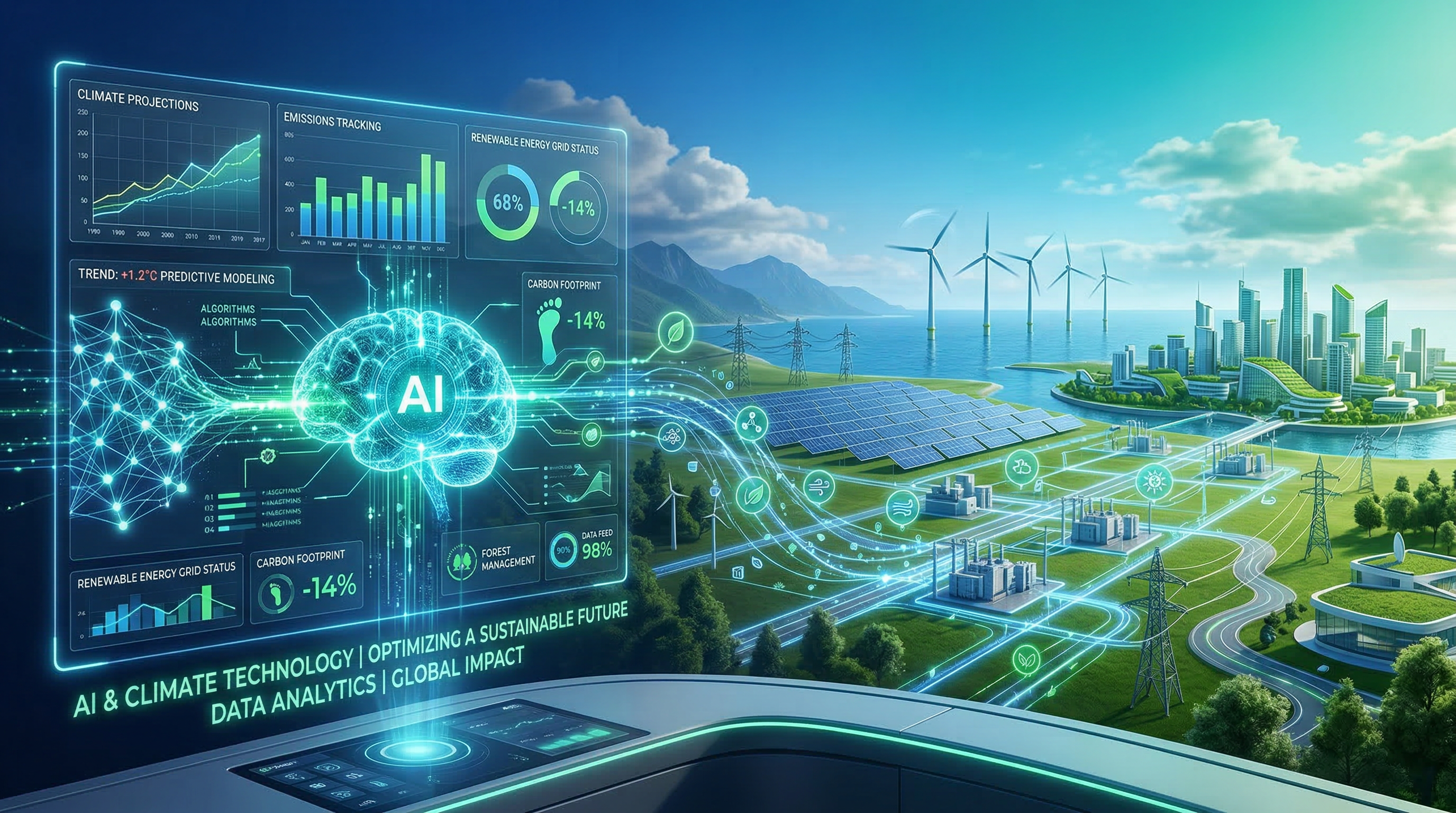
The $1.3 Trillion Opportunity: Why AI Matters for Climate
The World Economic Forum estimates that AI-driven energy efficiency measures and smart grid technologies could generate up to $1.3 trillion in economic value by 2030. More importantly, research from Yale's Clean Energy Forum demonstrates that AI applications in energy systems can reduce carbon emissions by up to 50% in certain contexts, particularly in grid optimization and renewable energy forecasting.
The convergence of artificial intelligence and climate technology represents one of the most promising developments in the fight against global warming. As the world races toward ambitious climate targets set by the Paris Agreement, AI is emerging as an essential tool for optimizing existing clean technologies, accelerating the discovery of new solutions, and managing the complex systems required for a sustainable energy future.
Transforming the Electrical Grid: The Foundation of Clean Energy
The electrical grid is perhaps the domain where AI's impact on climate action is most immediately felt. Modern power grids must balance supply and demand in real time across millions of nodes, integrate intermittent renewable energy sources like solar and wind, and maintain stability while transitioning away from baseload fossil fuel generation.
Predictive Analytics for Renewable Integration
One of the greatest challenges facing renewable energy adoption is the inherent variability of solar and wind power. The sun does not always shine, and the wind does not always blow, creating forecasting challenges that can destabilize grid operations. AI algorithms trained on historical weather data, satellite imagery, and real-time sensor networks can now forecast renewable energy generation with remarkable accuracy often exceeding 95% for 24-hour predictions.
Companies like Google DeepMind have demonstrated that machine learning models can predict wind farm power output 36 hours in advance with sufficient accuracy to make wind energy as reliable as conventional generation for grid operators. This predictive capability allows utilities to schedule backup generation more efficiently, reduce curtailment of renewable energy, and increase the overall penetration of clean power on the grid.
Real-Time Grid Optimization
Beyond forecasting, AI systems actively optimize grid operations in real time. Researchers at MIT have developed reinforcement learning algorithms that continuously adjust grid dispatch decisions to minimize costs and emissions. These systems consider thousands of variables simultaneously including electricity demand patterns, renewable generation forecasts, energy storage state, electricity prices, and grid constraints to make optimal dispatch decisions every few minutes.
The results are striking. Utilities implementing AI-based grid management systems report 10-15% reductions in operational costs and corresponding decreases in carbon emissions, even before adding new renewable capacity. As these systems become more sophisticated and widely deployed, they will be essential for managing grids with 80% or higher renewable penetration.
AI Impact on Grid Efficiency (2020-2026)
Comparison of traditional vs AI-optimized grid management systems
Optimizing Renewable Energy Assets: Making Clean Power More Efficient
Beyond grid-level optimization, AI is improving the performance of individual renewable energy assets. These applications range from wind turbine control to solar tracking to building energy management, each contributing incremental efficiency gains that compound into significant emissions reductions.
Wind Farm Intelligence
Wind turbines are remarkably complex machines, and their efficiency depends on countless factors including wind speed, wind direction, turbulence, temperature, air pressure, and the wake effects from neighboring turbines. AI systems can optimize turbine operations in real time by adjusting blade pitch, yaw angle, and rotor speed to maximize energy capture while minimizing mechanical stress.
Siemens Gamesa has deployed AI-powered control systems across its wind farm portfolio that analyze data from multiple turbines simultaneously to optimize the entire farm's output rather than individual turbines. By reducing wake interference between turbines and adjusting for atmospheric conditions, these systems increase energy production by 2-5% on average, a substantial improvement given the scale of modern wind installations.
Solar Tracking and Maintenance
Solar photovoltaic systems benefit from AI in multiple ways. Machine learning models optimize solar tracker algorithms to follow the sun's path more accurately throughout the day and year. Computer vision systems inspect solar panels using drone imagery to detect defects, soiling, and degradation far more quickly and accurately than human inspectors. For a comprehensive overview of emerging solar technologies, see our complete guide to green technology in 2026.
Perhaps most significantly, AI enables predictive maintenance for solar installations. By analyzing performance data patterns, AI systems can identify underperforming panels or inverters and predict component failures before they occur, minimizing downtime and maximizing energy generation over the system's lifetime.
Building Energy Management
Buildings account for approximately 40% of global energy consumption and a similar proportion of emissions. AI-powered building management systems optimize heating, ventilation, air conditioning (HVAC), and lighting based on occupancy patterns, weather forecasts, electricity prices, and individual comfort preferences.
Johnson Controls and Honeywell have deployed AI building management platforms across commercial real estate portfolios, achieving energy reductions of 10-20% without compromising occupant comfort. These systems learn from historical data and continuously adapt to changing conditions, getting more efficient over time.
Related Reading: To understand how renewable energy technologies are advancing alongside AI optimization, explore our comprehensive analysis of next-generation perovskite solar cells and their potential to revolutionize clean energy generation.
Accelerating Green Technology Discovery: AI in the Lab
Perhaps AI's most transformative role in climate action is accelerating scientific discovery itself. Developing new materials for solar cells, battery electrodes, catalysts for green hydrogen production, and carbon capture technologies traditionally requires years of laboratory work screening thousands of potential candidates. AI is compressing this timeline from years to months or even weeks.
Materials Discovery for Clean Energy
Machine learning models trained on materials databases can predict the properties of millions of potential compounds without synthesizing them in the lab. This capability allows researchers to narrow the field to the most promising candidates before beginning experimental work.
A team at Berkeley Lab used AI to screen 300 million potential materials for solid-state battery electrolytes, identifying 6,000 candidates worthy of further study in just a few weeks. Manual screening would have taken decades. Several of these AI-discovered materials have already shown promising results in laboratory testing and may lead to the next generation of energy storage technology.
Similarly, researchers at Monolith Materials are using machine learning to optimize catalysts for converting methane into hydrogen and solid carbon, a process that could enable low-emissions hydrogen production while sequestering carbon. The company reports that AI has accelerated their catalyst development cycle by a factor of 10 compared to traditional methods.
Accelerating Battery Development
Battery technology is central to both electric vehicle adoption and grid-scale energy storage. AI is accelerating battery research across multiple fronts, from discovering new electrode materials to optimizing electrolyte formulations to predicting battery degradation patterns.
Toyota and Samsung SDI, both leading the race toward commercial solid-state batteries, leverage AI extensively in their research programs. Machine learning models help identify promising material combinations, simulate battery performance under various conditions, and optimize manufacturing processes. These AI-accelerated development programs are bringing solid-state batteries closer to commercial reality, potentially revolutionizing electric vehicle range and charging times.
Deep Dive: Learn more about the battery revolution in our article on the race to build the world's first commercial solid-state battery, where AI-driven materials discovery is playing a crucial role.
AI Acceleration in Clean Tech R&D
Time savings in research and development cycles
Enhancing Carbon Capture and Removal Technologies
Even with aggressive emissions reductions, achieving net zero by 2050 will likely require large-scale carbon dioxide removal to address historical emissions and hard-to-abate sectors. AI is improving carbon capture technologies in multiple ways, from optimizing chemical processes to identifying optimal deployment locations.
Optimizing Direct Air Capture
Direct air capture (DAC) technologies remove CO2 directly from the atmosphere using chemical processes. These systems are energy-intensive and expensive, making optimization critical for economic viability. AI systems optimize DAC operations by adjusting chemical flow rates, temperature, and pressure based on atmospheric conditions, energy prices, and equipment state.
Climeworks, a leader in direct air capture, uses machine learning to optimize its facility operations continuously. The company reports that AI optimization has reduced energy consumption per ton of CO2 captured by approximately 15%, a meaningful improvement for an energy-intensive process.
Site Selection and Monitoring
AI algorithms analyze geological data, satellite imagery, and environmental factors to identify optimal locations for carbon sequestration projects. Machine learning models can predict how injected CO2 will behave underground, assess leakage risks, and recommend monitoring strategies.
Perhaps most importantly, AI-powered monitoring systems verify that sequestered carbon remains underground. Computer vision algorithms analyze satellite data to detect any surface changes that might indicate CO2 leakage, while seismic monitoring systems use machine learning to interpret underground sensor data and ensure storage integrity.
Related Article: For a comprehensive overview of carbon capture technologies and their deployment at scale, read our analysis: Carbon Capture at Scale: The Race to Remove CO2 from the Atmosphere.
Smart Transportation and Logistics
Transportation accounts for approximately 25% of global CO2 emissions. AI is optimizing transportation systems in numerous ways, from route planning to traffic management to electric vehicle charging strategies.
Fleet Optimization and Route Planning
Logistics companies use AI to optimize delivery routes, consolidate shipments, and reduce empty return trips. UPS reports that its AI-powered routing system, ORION (On-Road Integrated Optimization and Navigation), saves the company 10 million gallons of fuel annually by optimizing delivery routes.
For electric vehicle fleets, AI systems optimize charging schedules to take advantage of low electricity prices and high renewable energy availability, while ensuring vehicles are charged when needed. This intelligent charging reduces grid stress and maximizes the use of clean energy.
Traffic Management and Autonomous Vehicles
AI-powered traffic management systems reduce congestion and emissions in urban areas. By analyzing traffic patterns in real time and adjusting signal timing, these systems can reduce stop-and-go traffic that increases fuel consumption and emissions.
Looking ahead, autonomous vehicles guided by AI will enable platooning (vehicles traveling closely together to reduce aerodynamic drag), optimize acceleration and braking patterns, and participate in shared mobility services that reduce the total number of vehicles needed.
AI Climate Applications: By The Numbers
The Energy Paradox: AI's Own Carbon Footprint
It would be intellectually dishonest to discuss AI's climate benefits without addressing its own environmental costs. Training large AI models requires enormous computational resources and consequently substantial electricity consumption.
Understanding the Energy Cost
Research from the University of Massachusetts Amherst found that training a single large natural language model can emit as much carbon as five cars over their lifetimes. The rapid growth in AI applications and model sizes has raised legitimate concerns about AI's net impact on emissions.
However, this analysis requires nuance. First, most AI applications for climate benefit do not require training massive models from scratch. Many use transfer learning, fine-tuning existing models for specific tasks with a fraction of the energy cost. Second, once trained, AI models can be deployed millions of times with minimal additional energy cost.
The Path to Sustainable AI
The resolution to AI's energy paradox lies in several strategies. First, running AI infrastructure on renewable energy makes the biggest difference. Google reports that its data centers operate at 95% carbon-free energy globally, substantially reducing the carbon intensity of AI training and deployment.
Second, researchers are developing more efficient AI algorithms that require less computation to achieve similar results. Techniques like model pruning, quantization, and efficient architectures can reduce energy requirements by 50-90% compared to naive approaches.
Third, specialized AI hardware like TPUs (Tensor Processing Units) and other accelerators are far more energy-efficient than general-purpose processors for AI workloads. As these specialized chips become more widely available, the energy cost per AI inference will continue to decline.
Finally, the net calculation is overwhelmingly positive. Even accounting for AI's energy consumption, the emissions reductions enabled by AI applications far exceed the emissions from training and running AI systems. The key is ensuring AI development and deployment prioritizes climate-positive applications.
Industry Leaders and Notable Applications
Numerous companies and organizations are pioneering AI applications for climate action. Here are some notable examples:
Google and DeepMind
Google's DeepMind has achieved multiple breakthroughs in AI for climate. Their wind power forecasting system increases the value of wind energy by making it more predictable. Their data center cooling optimization AI has reduced Google's cooling energy costs by 40%, saving both money and emissions.
Microsoft AI for Earth
Microsoft's AI for Earth program provides AI tools and cloud resources to organizations working on climate, agriculture, biodiversity, and water challenges. The program has supported over 800 projects in 100 countries, democratizing access to AI for environmental applications.
IBM's Environmental Intelligence Suite
IBM offers an Environmental Intelligence Suite combining AI, weather data, and climate risk analytics to help organizations monitor and respond to environmental challenges. The platform helps utilities integrate renewable energy, helps businesses assess climate risks, and assists governments with disaster response planning.
Tesla Autopilot and Fleet Learning
Tesla leverages AI across its vehicle fleet to optimize energy efficiency. The company's neural networks learn from millions of miles of driving data to improve Autopilot efficiency and provide drivers with energy-optimized route suggestions.
DeepMind Wind Forecasting
Google DeepMind launches AI system for predicting wind farm power output 36 hours in advance, increasing wind energy value by 20%.
Berkeley Lab Materials Discovery
Researchers use AI to screen 300 million battery materials, accelerating solid-state battery development.
AI-Optimized Grid Management
Major utilities deploy AI grid optimization achieving 10-15% cost reductions and emissions savings.
Mainstream AI Climate Integration
AI becomes standard in renewable energy operations, building management, and climate research worldwide.
Challenges and Limitations
Despite its promise, AI for climate faces several challenges that must be addressed for the technology to reach its full potential.
Data Quality and Availability
AI systems are only as good as their training data. Many climate applications require high-quality sensor data, weather information, and operational metrics that may not be available, especially in developing countries. Addressing this data gap requires investment in sensor networks and data infrastructure.
Algorithmic Bias and Equity
AI systems trained primarily on data from developed countries may not perform well in different contexts. There is a risk that AI climate solutions could exacerbate existing inequalities if not deployed thoughtfully. Ensuring equitable access to AI technology and training models on diverse data sets is essential.
Integration with Existing Systems
Many energy systems and industrial processes were designed decades ago without consideration for AI integration. Retrofitting these systems with the sensors and communication capabilities needed for AI optimization can be expensive and technically challenging.
Regulatory and Trust Barriers
In some contexts, particularly utility regulation, AI-driven decision making faces skepticism from regulators and the public. Building trust in AI systems and developing appropriate regulatory frameworks will be important for widespread adoption.
The Road Ahead: AI's Role in Net Zero by 2050
Looking toward 2050, AI will likely be indispensable for achieving net zero emissions. The complexity of managing highly renewable power grids, optimizing billions of devices in the Internet of Things, coordinating international carbon markets, and rapidly developing new clean technologies will require computational capabilities beyond human capacity.
The International Energy Agency's roadmap to net zero includes AI as a key enabling technology. The organization projects that AI-driven efficiency improvements could contribute 10-15% of the emissions reductions needed to reach net zero, a substantial portion of the solution.
However, AI is not a silver bullet for climate change. It is a multiplier, a technology that makes every other clean technology work better, faster, and cheaper. The fundamental solutions remain the same: transitioning to renewable energy, electrifying transportation, improving energy efficiency, transforming industrial processes, and protecting natural ecosystems. AI accelerates all of these transitions.
Conclusion: The Invisible Revolution
Artificial intelligence is quietly becoming one of the most powerful tools in humanity's response to climate change. From optimizing power grids to accelerating materials discovery, from reducing building energy consumption to enhancing carbon capture technologies, AI is making tangible contributions to emissions reductions and clean energy deployment.
Unlike more visible climate technologies like solar panels or electric vehicles, AI's impact is often invisible, operating behind the scenes to optimize systems and accelerate innovation. Yet its influence is profound and growing.
As we race toward the critical 2050 net zero deadline, we will need every tool at our disposal. The good news is that AI is already proving its worth, delivering measurable climate benefits across multiple sectors. The challenge now is scaling these applications globally, ensuring equitable access, and addressing AI's own environmental footprint.
The convergence of artificial intelligence and climate technology is not just a technological development. It represents a new paradigm for how humanity tackles its greatest challenges using the most advanced computational tools ever created. The AI revolution in climate action has begun, and its impact will only grow in the years ahead.
Continue Reading: Explore the broader landscape of future green technology in 2026 to understand how AI fits into the complete ecosystem of climate solutions, from next-generation batteries to electric aviation.
About the Authors
Future Green Tech Editorial Team consists of climate technology journalists, engineers, and analysts who track the latest developments in green technology from research labs to commercial deployment. Our team combines technical expertise with investigative journalism to provide readers with accurate, in-depth analysis of sustainable technologies shaping our future. All articles are fact-checked and based on publicly available data, peer-reviewed research, and official company announcements.