Carbon Capture: Can We Actually Pull CO₂ From the Sky at Scale?
Even in the most optimistic scenarios for emissions reduction, the math of climate change increasingly demands a technology that can remove carbon dioxide already in the atmosphere. This is the domain of direct air capture (DAC) — technology designed to pull CO₂ directly out of ambient air, regardless of where it was originally emitted.
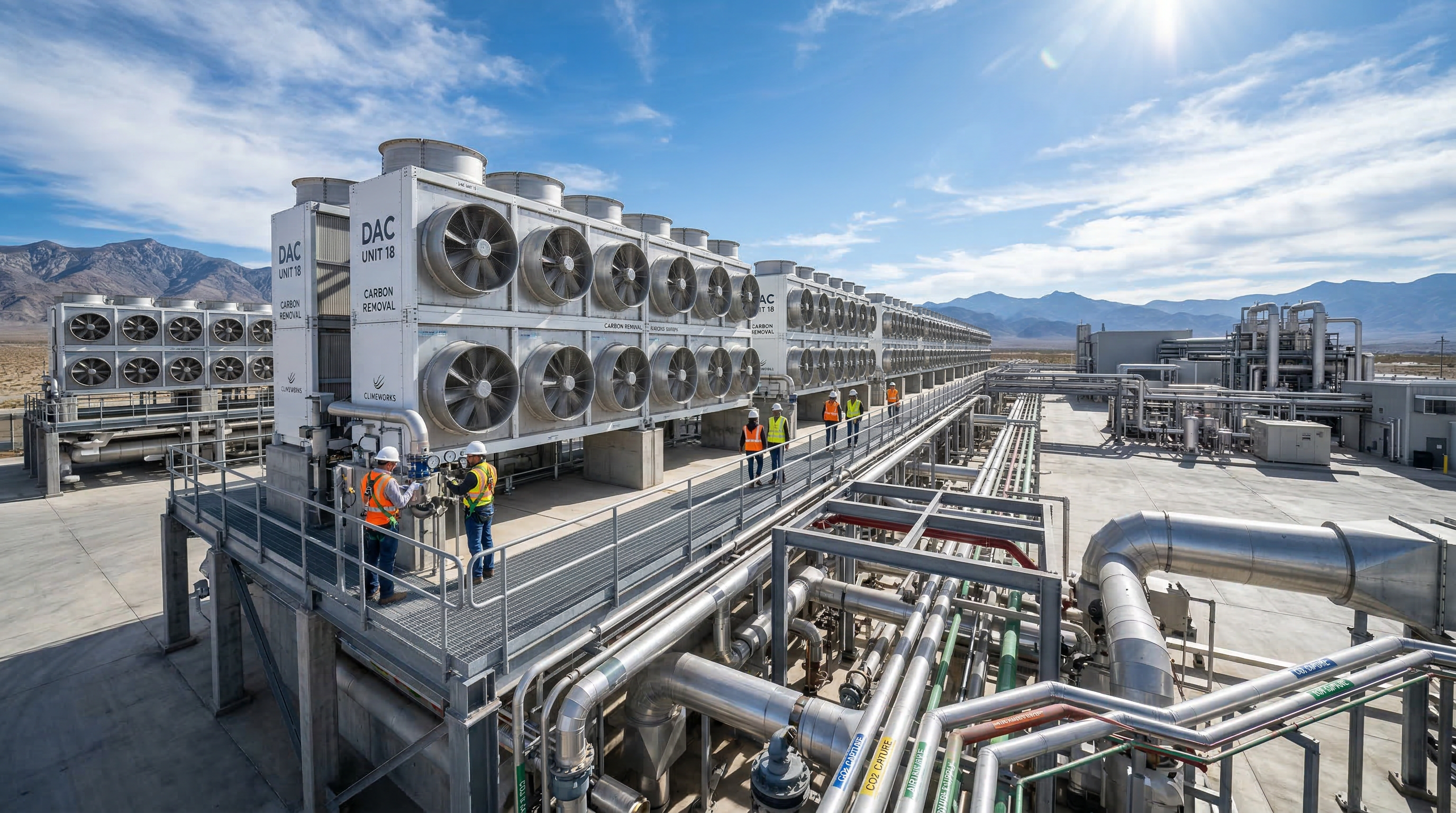
Even in the most optimistic scenarios for emissions reduction, the math of climate change increasingly demands a technology that can remove carbon dioxide already in the atmosphere. This is the domain of direct air capture (DAC) — technology designed to pull CO₂ directly out of ambient air, regardless of where it was originally emitted.
In 2026, DAC stands at a pivotal moment. The technology works. Plants are operating in Iceland, Switzerland, the United States, and Canada. But the gap between what's technically feasible and what's economically and physically scalable remains enormous. The central question facing the industry is no longer "can we do it?" but rather "can we do it fast enough, cheap enough, and at a large enough scale to make a meaningful difference?"
The Promise and the Challenge
The appeal of direct air capture is straightforward: it addresses the carbon that's already in the atmosphere. Unlike point-source carbon capture, which captures emissions at power plants or industrial facilities, DAC can theoretically be deployed anywhere — even in locations with abundant renewable energy and ideal geological storage sites far from emission sources. This pairs particularly well with next-generation solar technologies that can provide the massive amounts of clean energy DAC requires.
But atmospheric CO₂ is dilute — roughly 420 parts per million, or about 0.04% of air by volume. Extracting it requires moving enormous volumes of air through chemical processes that bind and release CO₂. This takes significant energy, specialized materials, and substantial infrastructure. The International Energy Agency (IEA) estimates that to contribute meaningfully to climate targets, DAC capacity needs to reach 85 million tonnes per year by 2030 and nearly 1 billion tonnes by 2050. Current capacity sits at around 10,000 tonnes annually — eight-five thousand times short of the 2030 goal. Artificial intelligence is increasingly being deployed to optimize these energy-intensive processes and reduce costs.
How Direct Air Capture Works
There are two primary technological approaches to DAC, each with distinct advantages and challenges.
1. Liquid Solvent Systems
Carbon Engineering, a Canadian company backed by investors including Bill Gates and Occidental Petroleum, uses a liquid solvent-based approach. Ambient air is drawn into large cooling-tower-like structures called contactors, where it comes into contact with an alkaline solution (typically potassium hydroxide). The CO₂ reacts with the solution to form a carbonate compound.
This carbonate solution is then processed through a series of chemical reactions — including heating to temperatures around 900°C — to release pure CO₂ gas, which can be compressed and either stored underground or used in industrial applications. The chemical solvent is regenerated and reused in a closed loop.
The advantage of this approach is that the chemistry is well-understood and industrially proven at smaller scales. The challenge is the high energy requirement, particularly for the thermal regeneration step.
2. Solid Sorbent Systems
Climeworks, a Swiss company and the current market leader in deployed DAC capacity, uses solid sorbent materials. Their modular collectors are filled with a proprietary filter material that selectively binds CO₂ when air is passed through at ambient temperature.
Once the filters are saturated with CO₂, the collector is sealed and heated to around 80–100°C, releasing the concentrated CO₂. The filters then cool and the cycle repeats. This approach requires significantly less heat than liquid solvent systems, making it more compatible with renewable heat sources and waste heat from industrial processes.
Climeworks' flagship facility, Orca, launched in Iceland in 2021, captures 4,000 tonnes of CO₂ per year. Their larger facility, Mammoth, currently under construction and partially operational, is designed to capture 36,000 tonnes annually when fully completed — making it the largest DAC plant in the world.
The Economics: Why DAC Is So Expensive
Current DAC costs range from $600 to $1,000 per tonne of CO₂ captured — and that's at small scale with first-generation technology. For context, the European Union's carbon price hovers around €70–90 per tonne (roughly $75–95), and voluntary carbon offset prices typically range from $10 to $50 per tonne.
The cost breakdown reveals the challenge:
- Energy: DAC is fundamentally energy-intensive. Estimates suggest that capturing 1 tonne of CO₂ requires 1,500–2,500 kWh of energy (both thermal and electrical). At typical renewable electricity costs, this represents a significant portion of total costs.
- Capital expenditure: Building DAC facilities requires specialized equipment, materials, and infrastructure. First-of-a-kind plants face especially high capital costs.
- Sorbent materials: The chemical filters and sorbents degrade over time and must be replaced, adding ongoing operational costs.
- Monitoring and verification: Rigorous measurement, reporting, and verification systems are needed to ensure captured CO₂ is genuinely removed from the atmosphere permanently.
However, both Carbon Engineering and Climeworks project that costs can fall below $200 per tonne with scale, improved materials, and integration with low-cost renewable energy. The U.S. Department of Energy has set a goal of $100 per tonne by the mid-2030s.
Where the Captured CO₂ Goes
Capturing CO₂ is only half the equation. What happens to it afterward determines whether DAC genuinely removes carbon from the atmosphere or simply delays its re-release.
Permanent Geological Storage
The most climate-effective option is geological sequestration — injecting CO₂ deep underground into porous rock formations where it remains trapped for thousands of years. Climeworks' Orca and Mammoth facilities in Iceland use a process called mineralization, injecting CO₂ into basaltic rock where it reacts with minerals to form stable carbonates in less than two years.
Occidental Petroleum and Carbon Engineering are developing a large-scale DAC facility in Texas's Permian Basin, where captured CO₂ will be stored in depleted oil and gas reservoirs.
CO₂ Utilization
Some captured CO₂ can be used to produce synthetic fuels, chemicals, concrete, or other products. However, unless the carbon remains locked away permanently, this doesn't constitute genuine carbon removal. Sustainable aviation fuels synthesized from DAC-sourced CO₂ will eventually release that carbon when burned — though they do avoid extracting new fossil carbon from the ground. As industries adopt circular economy principles, finding permanent uses for captured carbon in building materials becomes increasingly viable.
For DAC to count as legitimate carbon removal, CO₂ must either be stored permanently or used in products that sequester carbon for centuries, such as building materials.
Government Support and Investment
Recognizing that DAC won't scale on market forces alone, governments are stepping in with significant funding.
The U.S. Inflation Reduction Act expanded the 45Q tax credit, offering $180 per tonne for CO₂ captured via DAC and permanently stored — the most generous incentive globally. The U.S. Department of Energy has committed up to $3.5 billion to develop four Regional DAC Hubs, each aiming to capture at least 1 million tonnes of CO₂ per year.
The European Union is developing a carbon removal certification framework, and countries including Canada, the UK, and Japan have announced DAC research and deployment programs. Private funding is also growing, with companies including Microsoft, Stripe, Shopify, and McKinsey purchasing carbon removal credits to meet net-zero commitments.
The Players: Who's Building DAC
Beyond Climeworks and Carbon Engineering, several other companies are entering the field:
- Heirloom Carbon (U.S.): Uses an accelerated mineralization process with limestone to capture CO₂ at lower energy costs.
- CarbonCapture Inc. (U.S.): Modular DAC systems using solid sorbents, aiming for rapid deployment at scale.
- Global Thermostat (U.S.): Solid sorbent technology with lower temperature regeneration, reducing energy costs.
- Mission Zero Technologies (UK): Developing electrochemical DAC systems powered directly by renewable electricity.
The Criticism: Is DAC a Distraction?
Not everyone is convinced that massive investment in DAC is the right priority. Critics argue that DAC creates moral hazard — providing an excuse for governments and industries to delay the aggressive emissions cuts that remain the cheapest and most effective climate solution.
The numbers support this concern. Capturing and storing 1 tonne of CO₂ via DAC costs hundreds of dollars. Avoiding that same tonne through renewable energy deployment, energy efficiency, or electrification typically costs far less. Some climate scientists argue that scarce climate funding should prioritize emissions reduction over removal.
There's also the risk of greenwashing. Companies purchasing small amounts of carbon removal credits while continuing high-emission business models can use DAC to claim carbon neutrality without meaningful operational change.
The Consensus View: We Need Both
Despite legitimate concerns, the scientific consensus has shifted. The Intergovernmental Panel on Climate Change (IPCC) states clearly that limiting warming to 1.5°C will require not just deep emissions cuts, but also large-scale carbon dioxide removal. Even aggressive decarbonization leaves residual emissions from aviation, agriculture, and industrial processes that are difficult or impossible to eliminate entirely.
Carbon removal isn't a substitute for emissions reduction — it's a necessary complement. The goal is to achieve net-zero emissions, where any remaining emissions are balanced by equivalent removals.
The Realistic Timeline
What does scaling look like in practice? Current global DAC capacity is around 10,000 tonnes per year. The announced project pipeline suggests capacity could reach 1 million tonnes annually by 2030 — still far short of the IEA's 85 million tonne target.
Reaching gigaton scale — where DAC makes a measurable dent in atmospheric CO₂ — would require tens of thousands of large facilities, each capturing millions of tonnes per year. That level of deployment won't happen without sustained policy support, continued cost reductions, and integration with low-cost renewable energy at massive scale.
Realistically, DAC will likely remain a niche technology through the 2020s, with meaningful scaling beginning in the 2030s if cost and performance targets are met. By mid-century, it could play a significant role in a broader carbon management portfolio — but only if we also dramatically reduce emissions in the first place.
Technical Innovations on the Horizon
Researchers are exploring multiple pathways to reduce DAC costs and energy requirements:
Advanced Sorbent Materials
Metal-organic frameworks (MOFs) and covalent organic frameworks (COFs) offer precisely engineered pore structures that can selectively bind CO₂ with higher capacity and lower regeneration temperatures than current materials. Research teams at MIT, UC Berkeley, and ETH Zurich have demonstrated MOFs that can capture CO₂ at ambient conditions and release it with modest heating below 80°C.
Electrochemical Systems
Rather than using heat to regenerate sorbents, electrochemical DAC applies electrical voltage to drive CO₂ absorption and release. This approach can use renewable electricity directly without thermal conversion losses. Mission Zero Technologies and Verdox are commercializing electrochemical systems that promise lower costs and higher efficiency than thermal processes.
Ocean-Based Alkalinity Enhancement
While not direct air capture per se, enhancing ocean alkalinity through mineral dissolution can accelerate natural CO₂ uptake by seawater. The ocean already absorbs roughly 10 billion tonnes of CO₂ annually. Adding alkaline minerals can increase this capacity while also counteracting ocean acidification. This approach is still in early research stages but could complement terrestrial DAC.
Integration with Industrial Processes
Some of the most promising near-term opportunities involve integrating DAC with existing industrial facilities that have waste heat, low-cost renewable electricity, or geological storage infrastructure already in place. Cement plants, geothermal facilities, and data centers are all being evaluated as potential DAC host sites where synergies could reduce costs significantly.
The Role of Corporate Commitments
While government funding has been crucial, corporate demand for carbon removal credits is accelerating deployment. Companies including Microsoft, Stripe, Shopify, Alphabet, and McKinsey have collectively committed hundreds of millions of dollars to purchasing carbon removal credits through initiatives like the Frontier coalition.
These advance market commitments provide revenue certainty that helps DAC companies secure financing for new facilities. Stripe, for example, has committed over $15 million to carbon removal purchases since 2020, with significant allocations to DAC projects. This corporate demand is creating a market pull that complements government policy push.
However, corporate carbon removal purchasing remains orders of magnitude below what's needed. The entire voluntary carbon market for removal credits is currently worth less than $2 billion annually — far too small to drive gigaton-scale deployment.
The Bottom Line
Direct air capture works. It's technically feasible, and it's being deployed. But it's expensive, energy-intensive, and nowhere near the scale needed to address climate change. The technology will improve and costs will fall, but DAC should never be viewed as a silver bullet or an excuse to delay aggressive decarbonization.
The most productive way to think about DAC is as essential insurance — a necessary backstop for hard-to-eliminate emissions and a tool for eventually drawing down atmospheric CO₂ concentrations after we've reached net zero. But the primary focus must remain on preventing emissions in the first place. We can't capture our way out of the climate crisis. But if deployed responsibly, DAC can be part of the solution.